
Cultivating the Future: Organic Farming, Land Stewardship, and the Fetzer Legacy at Masút
Organic and regenerative farming is crucial to restoring ecosystems and sustaining future food systems. Causeway Impact celebrates leaders like the Fetzer family, who embody true environmental stewardship.
.png)
As pressure mounts on global food systems, the importance of organic and regenerative farming has become impossible to ignore. Organic practices not only protect ecosystems and reduce chemical dependencies, but restore soil health, support biodiversity, and help preserve the land for future generations. At Causeway Impact, we remain committed to elevating leaders whose work demonstrates what long-term stewardship can look like. Few families embody this ethic as powerfully as the Fetzers.
For more than 50 years, the Fetzer family has been a pioneering force in organic viticulture. Barney and Kathleen Fetzer, who founded Fetzer Vineyards in 1968, championed sustainable agriculture decades before it entered mainstream consciousness. By the early 1990s they were farming over 3,000 certified-organic acres in Mendocino County—long before “regenerative” was a buzzword and when most people still thought organic wine tasted like vinegar and good intentions.
Today, that legacy lives on through the third generation: brothers Ben and Jake Fetzer, proprietors of Masút Vineyard and Winery. Their work is not only a continuation of family tradition, it is a contemporary model of what responsible, land-centered, organic farming can achieve at the highest level. And while they share the same values, the brothers’ distinct personalities and complementary problem-solving styles are at the heart of Masút’s success.
A Vision Rooted in Family, Landscape, and Two Distinct Minds
Masút’s story began in 1994, when Ben and Jake’s parents, Robert (“Bobby”) and Sheila Fetzer, purchased a spectacular 1,200-acre property at the headwaters of the Russian River in what would later become the Eagle Peak Mendocino County AVA. Bobby understood intuitively that the site’s dramatic elevations, cooling winds, and varied soils had the potential to produce world-class Pinot Noir.
As teenagers, Ben and Jake helped clear the rugged land and plant the first vines. Those early years shaped not only the vineyard but the brothers themselves, revealing two equally passionate thinkers who approached challenges in very different ways.
Jake is methodical, analytical, and steady in his approach, often drilling into the technical layers of viticulture and winemaking. Ben is instinctive, kinetic, and deeply connected to the land’s feel, often the first to spot subtle changes in climate, soil, or canopy that signal a shift in what the vineyard needs.
Together, these contrasting perspectives form a creative and balanced partnership, one that blends rigor with intuition, precision with experimentation, an essential dynamic in building an organic estate that adapts to nature rather than forces nature to adapt to it.
The Masút Vineyard: Precision Meets Intuition
The Masút estate now consists of 19 individual organic blocks across two main sites:
- The Lower Vineyard (900 ft) East-facing, with gravelly clay soils shaped by thousands of years of weathered sedimentary rock; planted to Pinot Noir clones 113, 115, and 777.
- The Upper Vineyard (1,600 ft) Southwest-facing, with deep red sandstone soils; planted to Mariafeld, Mt. Eden, Swan, Dijon 96, and Masút’s own estate selection.
In classic brotherly fashion, one of them may lean toward data and block-by-block micro-analysis, while the other pulls from decades of observation and instinct. The interplay between these approaches is not only harmonious, it’s essential to Masút’s identity. Each block is vinified separately, aged up to 15 months in French oak, and bottled unfined and unfiltered, allowing the fullest expression of site, soil, and vintage.
Eagle Peak: A Region Defined and Protected
Ben and Jake were instrumental in the creation of the Eagle Peak Mendocino County AVA, approved in 2014. The region, defined by its cooler temperatures, persistent winds, and sandstone-and-shale soils, offers ideal conditions for organic Pinot Noir.
Drafting the AVA petition encapsulated their dynamic perfectly: one brother assembling data, climate charts, and soil analyses; the other walking the ridgelines, articulating how the land breathes differently than neighboring valleys. The result was a compelling, evidence-and-experience-driven case for a new American wine-growing region.
Their leadership not only elevated the region, but reinforced the importance of protecting its delicate ecosystems, cultural history, and agricultural future.
A Day at Masút: Soil, Stewardship, and 500-Year-Old Oak
On a recent visit, we had the opportunity to walk the property with the brothers. Rarely do we meet two who finish each other’s sentences, contradict each other’s childhood memories, and still—somehow—produce world-class Pinot Noir. That would be Ben and Jake Fetzer of Masút Vineyard and Winery, third-generation stewards of one of California’s most influential wine families.
At one point, Jake stopped mid-stride, knelt down, and lifted a handful of dark, almost black soil, rich, soft, and alive with centuries of decomposed organic matter. His excitement was infectious. “This,” he said, “is the whole story.”
It was a moment that captured Jake’s relationship with the land.
As teenagers, Ben and Jake were put to work clearing the brush and planting vines on hills so steep that “go play outside” came with a liability waiver. They grew up semi-feral in the best sense—running ridgelines, building questionable tree forts in 500-year-old oaks, and learning early that poison oak is nature’s way of saying “slow down.”
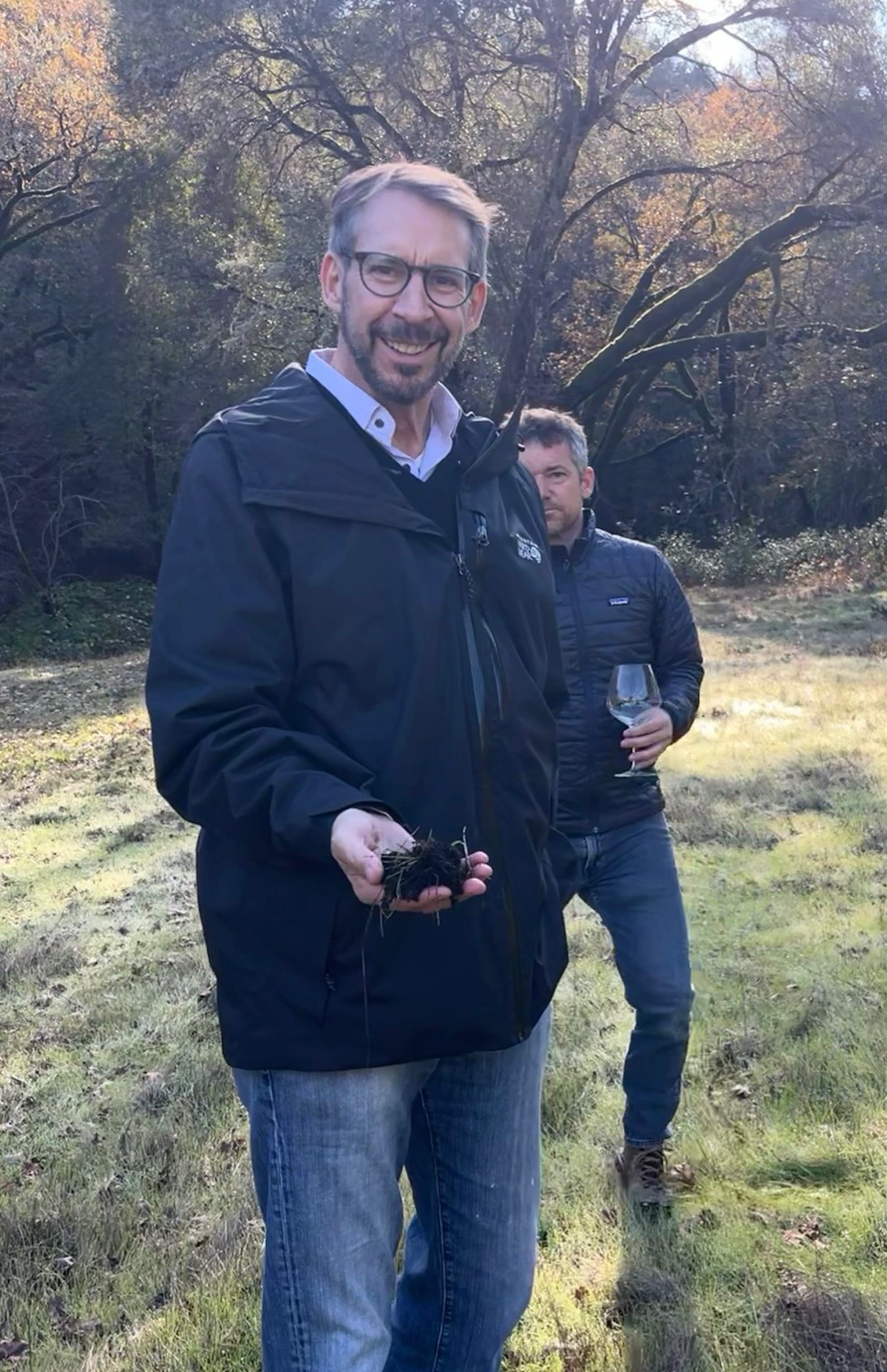
Later, as we discussed canopy management strategies and block-specific water retention patterns, Ben and Jake provided the deeper technical explanation, articulating the science behind what we had just seen and felt.
Two perspectives, one shared commitment.
Beyond the vineyard blocks, the estate is home to sweeping forests of old-growth oaks, some believed to be more than 500 years old. On a nearby Fetzer family property stands what is believed to be the largest valley oak in the world, rising more than 153 feet. It would take more than 20 people, arm-in-arm, to encircle its trunk.
The sense of place is overwhelming, an almost sacred reminder of why this land must be protected.
Craftsmanship, Recognition, and the Future of Masút
Since their first vintage in 2009, Masút’s wines have earned consistent acclaim for purity, elegance, and age-worthiness. Their Pinot Noir, bright with raspberry and cherry aromatics, layered with blackberry, spice, and subtle oak, has been praised in Wine Enthusiast and beyond.
Most recently, their 2023 Pinot Noir was named one of the Top 100 Wines of 2025, a testament to the brothers’ shared ambition and complementary strengths.
The Fetzers also recently launched Rural Wine Company, bringing the spirit of Eagle Peak to a broader audience while maintaining the integrity of their farming philosophy.
.png)
Why Their Work Matters
Organic farming is about more than avoiding synthetic inputs. It is about building healthy soil, restoring ecosystems, and honoring the land’s cultural history. It is about choosing stewardship over convenience, and long-term thinking over short-term yield.
The Fetzer brothers exemplify this balance, not because they think alike, but because they think together.
.png)
Their partnership at Masút shows what is possible when generational commitment meets organic farming, ecological responsibility, and two distinct but deeply aligned visions.
At Causeway Impact, we are honored to share their story and inspired by what their leadership means for the future of sustainable agriculture.